
How Many Treats per Day? The 10 Percent Rule
How many treats a dog can have per day is answered by the 10 percent rule: snacks, chews and rewards combined should make up no more than about 10 percent of your dog's daily energy needs. The remaining 90 percent or so should come from a balanced main diet. In this article, you'll learn how to estimate your dog's treat budget by body weight, how to put the calories in dog treats into perspective and how to deduct treats correctly from the daily food ration.
Content: How Many Treats per Day? The 10 Percent Rule
- What is the 10 percent rule for dogs?
- How many treats per day? A guide by body weight
- Calories in dog treats: what really matters
- Deducting treats from the food ration: how it works
- The right amount of treats in everyday life and training
- Frequently asked questions about treat amounts
- Conclusion: Reward with confidence using the 10 percent rule
Small meat cubes that are easy to portion:


What is the 10 percent rule for dogs?
The 10 percent rule states that treats and chews combined should provide no more than about one tenth of the calories your dog needs each day. That leaves enough room for the main diet, which supplies your dog with all the essential nutrients.
Why 10 percent?
A complete dog food is formulated to cover the need for protein, fat, vitamins and minerals. Treats, on the other hand, are usually complementary feeds – they taste great, but they are not designed to provide complete nutrition. If snacks make up too large a share of the diet, the balance can tip. The 10 percent limit is a widely used rule of thumb that is often recommended in animal nutrition and is easy to apply in everyday life.
What counts towards the 10 percent?
- Training treats such as meat cubes, softies or sausage slices
- Chews such as ears, scalp, chew sticks or tendons
- Chew bones and chew plates, even if they are chewed over several days
- Table scraps and “just a little piece” from family members
- Fillings for snuffle mats, lick mats or food toys
It's the many small extras that are easily underestimated. You can read more about why chews are no substitute for a complete meal in our article Why chews shouldn't be a main meal.
How many treats per day? A guide by body weight
How many treats your dog can have per day depends mainly on its weight and energy needs: a small dog has a snack budget of only a few dozen kilocalories, a large dog of well over a hundred.
Treat budget by body weight
The following table provides a rough guide for adult dogs of normal weight with average activity levels. The values were calculated with a common estimation formula for energy requirements and rounded. Your dog's actual needs may differ considerably depending on breed, age, neutering status, temperament and exercise.
| Body weight | Daily energy needs (approx.) | Treat budget under the 10 percent rule (approx.) |
|---|---|---|
| 5 kg | 300–400 kcal | 30–40 kcal |
| 10 kg | 550–700 kcal | 55–70 kcal |
| 20 kg | 900–1,150 kcal | 90–115 kcal |
| 30 kg | 1,250–1,550 kcal | 125–155 kcal |
| 40 kg | 1,550–1,950 kcal | 155–195 kcal |
What does that mean in grams?
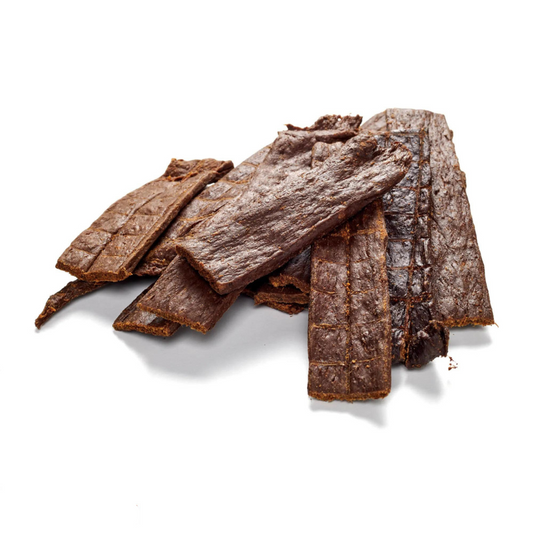
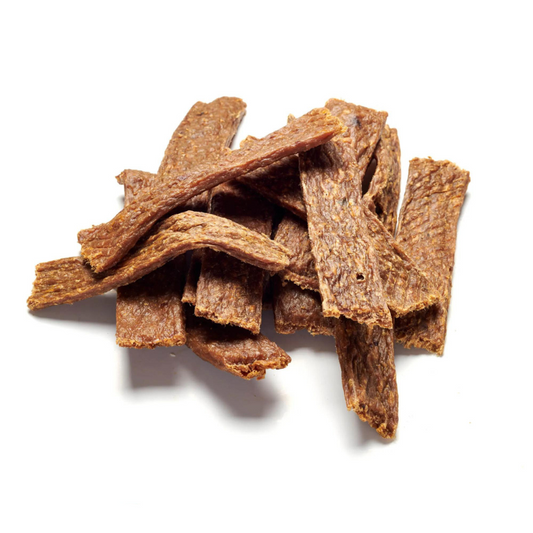
Dried meat snacks contain hardly any water and are therefore energy-dense. Depending on the type of meat and fat content, they often provide roughly 300 to 400 kcal per 100 g. For a 10 kg dog, the daily budget therefore equals about 15 to 20 g of dried snacks – a small handful of mini meat cubes rather than a whole bag. The information in the product description is always what counts.
When to adjust the budget
- Overweight: The snack budget should be smaller here and built into a diet plan together with your vet.
- Puppies and young dogs: They need a balanced main diet for healthy growth. Keep treats small and use part of the daily ration as rewards.
- Seniors: Older dogs often burn less energy. Soft, small snacks are usually the better choice here.
- Sporting and working dogs: They have higher energy needs – but the principle “snacks count too” still applies.
Calories in dog treats: what really matters
The calories in dog treats depend mainly on their fat and water content: lean, dried meats provide significantly less energy per gram than fatty sausages, ears or marrow bones.
Fat is the biggest calorie driver
Fat contains more than twice as much energy per gram as protein. A snack with a high crude fat content therefore has a bigger impact than a lean snack of the same size. Checking the “crude fat” value in the product description helps you compare. You'll find a wide selection of lean options in our low-fat chews category.
How many calories does a chew have?
There's no one-size-fits-all answer, because size, weight and composition vary greatly. A large cow ear or a chew plate alone can take up a considerable part of the daily budget, while a rabbit ear without fur is comparatively light. As a rule of thumb: the heavier and fattier the chew, the more calories it contains. If in doubt, weigh larger chews once and calculate using the energy value from the product description.
Lean snacks compared
| Type of snack | Energy density (tendency) | Tip |
|---|---|---|
| Lung cubes | low | light and airy, ideal for lots of small rewards, e.g. Lamb lung cubes mini |
| Dried rabbit, horse or chicken meat | low to medium | lean and easy to portion |
| Softies and soft cubes | medium | contain more moisture, easy to break up |
| Dog sausage and mini sausages | medium to high | cut into thin slices |
| Pig ears, marrow bones | high | plan them in only occasionally and deliberately |
Light rewards for lots of repetitions:


Deducting treats from the food ration: how it works
To prevent treats from leading to weight gain, simply deduct their calories from the daily food ration – that way the total energy intake stays the same, even if you reward a lot.
Step by step to the right ration
- Determine daily needs: Use the feeding guideline of your main food as a starting point and adjust it to your dog's weight and body condition.
- Set a snack budget: Allow about 10 percent of that for treats and chews.
- Work out the snack calories: You'll find the energy value in the product description or on the packaging, usually per 100 g.
- Reduce the main food: Deduct the snack calories from the food. A kitchen scale helps with dry food.
- Prepare the daily ration: Fill a small container with the day's snacks in the morning. Once it's empty, the budget is used up.
- Check regularly: Weigh your dog every few weeks and keep an eye on its body shape.
Example calculation
According to the feeding guideline, a 20 kg dog needs around 1,000 kcal per day. Its treat budget is therefore about 100 kcal. If it gets 100 kcal worth of snacks on a training day, you reduce its main food so that it only provides around 900 kcal. On days without training, it gets its normal portion.
You can check yourself whether your dog currently has a healthy weight using the rib test. You'll find more tips in our guide Obesity and weight management in dogs.
The right amount of treats in everyday life and training
The easiest way to get the amount of treats right is to use small pieces, reward deliberately and use part of the normal food as rewards.
Cut small, reward often
What matters most to your dog is that it gets rewarded – not how big the reward is. Pea-sized pieces are perfectly sufficient in training. Soft snacks such as softies are easy to break up, and Mini Chicken Sausages cut into thin slices make lots of small rewards. You'll also find suitable snacks in the training snacks category.
Practical tips for everyday life
- Grade your rewards: Normal dry food for easy exercises, special treats for difficult situations.
- Plan chews deliberately: A large chew replaces part of the other snacks on that day.
- Involve the family: Clear agreements prevent everyone from slipping the dog “just a little something”.
- Use alternatives: Praise, play, sniffing games or time together are valuable rewards too.
- Choose single-protein snacks: Snacks made from just one type of meat, such as Rabbit meat cubes mini, make it easier to keep track of tolerance and quantity.
Our article Training snacks for dog training explains how to use treats effectively in training.
Small snacks for sharing and rewarding:


Frequently asked questions about treat amounts
How many treats can my dog have per day?
As a rule of thumb, all treats and chews combined should provide no more than about 10 percent of daily energy needs. For a 10 kg dog, that's roughly 55 to 70 kcal – just a small handful of dried meat cubes. The exact amount depends on the calorie content of the snack.
How do I deduct treats from the food ration?
Work out the calories in the snacks using the product information and reduce the main food by exactly that amount of energy. The easiest way is to weigh out the day's treats in the morning and make the food portion smaller accordingly. A kitchen scale makes this much more accurate.
How many calories does a chew have?
That depends heavily on weight, size and fat content. Large or fatty chews such as pig ears or chew plates can take up a large part of the daily budget, while lean options such as rabbit ears or lung provide much less. You'll find the exact energy value in the product description.
Does the 10 percent rule also apply to puppies?
Yes – with puppies in particular, it's important that the main food makes up most of the ration so that their nutritional needs for growth are met. Use small pieces in training and feel free to use part of the puppy food as rewards. If you're unsure, ask your vet for advice.
What should I do if my dog gains weight despite the 10 percent rule?
Then the total energy intake is too high – perhaps the feeding recommendation is too generous for your dog, or unnoticed extras are being added. Reduce food and snacks gradually, and if your dog is clearly overweight, have your vet draw up a plan.
Conclusion: Reward with confidence using the 10 percent rule
The 10 percent rule is a simple guide to how many treats a dog can have per day: snacks and chews provide no more than about one tenth of the daily energy, and the rest comes from the main diet. If you choose small, lean snacks, deduct their calories from the food ration and check your dog's weight regularly, you can reward generously without your dog's figure suffering. If your dog is overweight, unwell or you're unsure, your vet is the right person to ask. You'll find a wide selection of natural snacks in our meat category.
Further articles on this topic:
- Dog treats: The little reward for your four-legged friend
- Low-Fat Dog Chews for Overweight Dogs & Pancreatitis
- Treats and snacks in dog training
This post was created with the help of AI