
Chewing against stress: how chews calm dogs
Chewing against stress works for dogs because steady chewing is a natural, self-soothing activity: many dogs become noticeably calmer while chewing, breathe more evenly and find it easier to settle down. A suitable chew can therefore help your dog release tension – for example after an exciting day, when staying home alone or in unfamiliar situations. In this article you will learn why chewing calms dogs, which chews are suitable and when it is best to offer them.
Content: Chewing against stress: how chews calm dogs
- Why does chewing help with stress? What happens in your dog
- Chewing against stress in dogs: recognising the signs
- Which chews help with stress?
- When should I give my dog something to chew to relax?
- Safe chewing: what you should pay attention to
- Frequently asked questions about chewing and stress
- Conclusion: chewing against stress – a natural source of calm
Natural chew sticks for relaxed chewing time:


Why does chewing help with stress? What happens in your dog
Chewing helps dogs with stress because the monotonous, rhythmic movement has a calming effect and gives your dog a meaningful task to focus on. Like licking or sniffing, chewing is one of the behaviours dogs use to regulate themselves.
Chewing as an innate need
Dogs descend from predators for whom chewing, tearing and gnawing were a fixed part of everyday life. This need is still present in every dog today – from the Chihuahua to the German Shepherd. When it is met, many dogs are more content and balanced. When it is not, they often find their own outlet: shoes, chair legs or the remote control.
Focus instead of tension
A chew demands attention. While your dog chews, it is busy with the smell, the taste and working on the chew. This distracts from stimuli that would otherwise excite it and helps many dogs to "switch off". Experts assume that the body's own messenger substances associated with well-being also play a role. You can read more about how the chewing muscles work in our article The secret of the chewing muscles.
What chewing cannot do
A chew is no substitute for training, exercise and closeness. With severe anxiety, panic or ongoing restlessness, chewing cannot remove the cause. In these cases it is important to find out what is behind the stress together with your vet or a dog trainer.
Chewing against stress in dogs: recognising the signs
For chewing against stress to help your dog in a targeted way, you first need to recognise when your dog is tense – because stress often shows itself more quietly than you might think.
Typical stress signals
- Body language: frequent yawning, nose licking, tucked tail, ears pinned back
- Restlessness: panting without heat or exertion, pacing, whining
- Displacement behaviour: sudden scratching, shaking or sniffing the ground
- Destruction: chewing furniture, cushions or shoes, especially when left alone
- Changed appetite: refusing food or gulping it down
Typical stress triggers
Common triggers are visitors, noise, car journeys, vet visits, moving house or a changed daily routine. Too much action can also be stressful: after a long outing, some dogs are so wound up that they cannot settle. You will find more tips on supporting your dog in such moments in our guide Calming dogs.
Which chews help with stress?
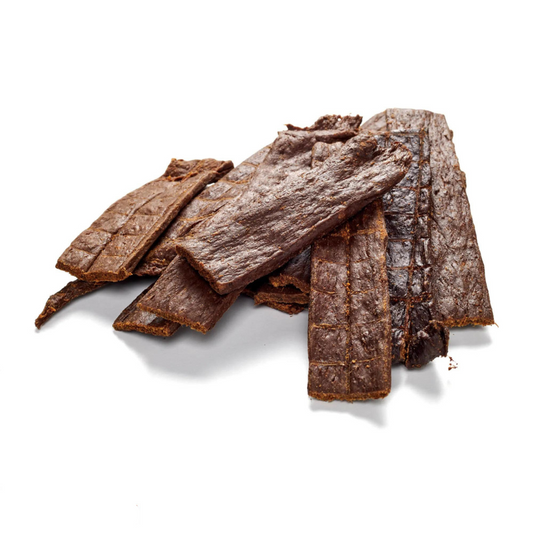
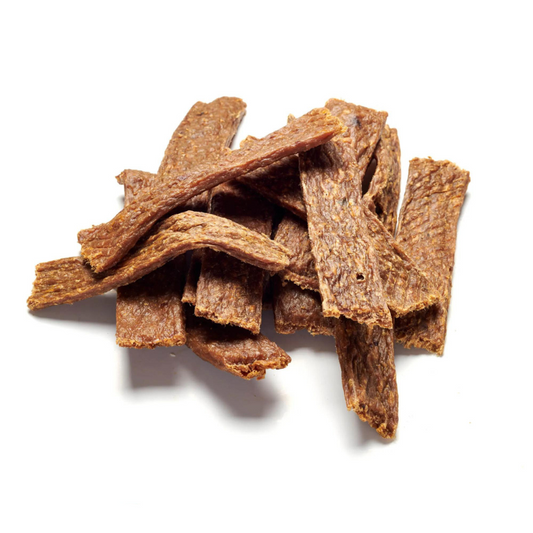
Chews that help most with stress are those your dog can chew on steadily for a long time without them being too hard – for example scalp sticks, buffalo hide, Achilles tendons or intestine sticks.
Long-lasting chews
For a calming chewing session, choose chews that do not disappear after a few minutes. A beef scalp chew or a buffalo hide stick keeps many dogs busy for quite a while. You will find a large selection in the category chew sticks. Hide chew bones such as the buffalo hide bone are also popular with dedicated chewers.
Tough, fibrous chews
Achilles tendons are tough and fibrous, so your dog has to work on them slowly. A beef Achilles tendon is a classic for medium-sized and large dogs; you will find more varieties under Achilles tendons.
Overview: chews and their suitability
| Chew | Chewing time (tendency) | Suitable for |
|---|---|---|
| Scalp sticks (beef, goat, camel) | medium to long | most adult dogs |
| Buffalo hide sticks and bones | long | dedicated chewers |
| Achilles tendons | medium | dogs that like tough chews |
| Intestine sticks | short to medium | small dogs and short rest breaks |
What to look for when choosing
- Right size: The chew should be clearly larger than your dog's mouth so that it cannot swallow it whole.
- Hardness: Very hard chews can strain the teeth. For relaxation, elastic, fibrous types are often more pleasant.
- Tolerance: For sensitive dogs, chews made from a single animal species help avoid intolerances.
- Naturalness: Dried chews without additives are a good choice.
Tough chews for quiet moments:


When should I give my dog something to chew to relax?
It is best to give your dog a chew when it is supposed to calm down – after excitement, before being left alone or during a fixed rest period – and not as a reward for restless behaviour.
Good moments for chewing time
- After the walk: When your dog is tired but still wound up, chewing helps the transition to rest.
- Before being left alone: A chew can make goodbyes more pleasant. Only give it if your dog can chew it safely without supervision.
- When visitors come: A quiet spot with a chew helps channel the excitement.
- Fixed rest rituals: Your dog will associate a daily chewing session on its blanket with relaxation.
Building rituals
Chewing is most effective when it becomes a fixed ritual: same place, same blanket, similar time of day. This way your dog learns that it is now time to rest. Always practise being left alone in small steps so that the chew does not become the only comfort.
Safe chewing: what you should pay attention to
For chewing to be truly relaxing, it has to be safe: choose the right size, watch your dog and include the calories of the chew in the daily ration.
Supervision and size
Especially with new chews, you should be there and watch how your dog chews. Take away very small leftovers so that it does not swallow them. Our article Leaving your dog alone with chews? explains which rules apply when your dog chews unsupervised.
Chewing time and calories
Even calming chewing sessions should not last forever. You can read how long your dog may chew depending on its age in How long should a dog chew?. Chews also provide energy – large chew sticks count towards the daily treat budget and should be deducted from the food.
Long-lasting chew bones and chew sticks:


Frequently asked questions about chewing and stress
Does chewing calm a dog?
Yes, chewing has a noticeably calming effect on many dogs. The steady movement and the focus on the chew help release tension. How strong the effect is, however, varies from dog to dog.
Which chews help with stress?
Long-lasting chews that are not too hard are well suited, such as scalp sticks, buffalo hide, Achilles tendons or intestine sticks. The right size and good tolerance are important. You will find a selection in our category Chewing fun.
When should I give my dog something to chew to relax?
Ideal moments are those in which your dog should calm down: after the walk, before being left alone or during a fixed rest period. If possible, give the chew when your dog is already a little calmer so that it does not associate restlessness with a reward.
Can too much chewing be harmful?
Too many or too large chews can lead to excess weight or digestive problems, and very hard chews can strain the teeth. Pay attention to a suitable amount and a reasonable chewing time.
Does chewing also help with fear, for example on New Year's Eve?
Chewing can help in mildly stressful situations, but it is no substitute for training or professional advice when a dog is genuinely afraid or panicking. If your dog is very anxious, talk to your vet about which measures make sense for your dog.
Conclusion: chewing against stress – a natural source of calm
Chewing is an innate need for dogs and can help them release stress and settle down. Long-lasting, natural chews in the right size, fixed chewing rituals and a watchful eye on safety and calories turn chewing time into a real source of calm in everyday life. If restlessness or anxiety persists, your vet is the right person to talk to. You will find suitable chews for every dog size in our category Chewing fun.
Further reading on this topic:
- Calming dogs - how to calm your four-legged friend
- The secret of the chewing muscles: why chewing makes dogs happy
- How long should a dog chew? Chewing time by age
This post was created with the help of AI